NEWS

Statement on the attack on Palestinian civilians

2023/10/22

Call to stop the attack on Palestinian civilians, to resolve conflict through dialogue, and to end the occupation

We condemn Hamas attacks targeting civilians, including killings, sexual violence, and kidnappings, and call for the immediate release of hostages. Perpetrators of serious crimes against humanity must be held accountable under international law.

However, these events cannot be understood outside of the context of Israel’s long-standing occupation and blockade, and the various human rights violations committed against Palestinian citizens. Moreover, we strongly condemn Israel’s indiscriminate retaliatory attacks on the Palestinian people as a whole, and call for a halt to invasion preparations that will only lead to further casualties.

Under the conditions in which the entire Gaza Strip is effectively a prison without the possibility of escape, emphasizing “humanitarian considerations” like evacuation orders and emergency aid for civilians must not be used as an excuse to make collective punishment for violations of international law seem more civilized. Of course humanitarian aid is necessary, but efforts must first be focused on preventing a ground invasion of Gaza and on establishing an immediate ceasefire.

We also express here our deep concern about reporting and discourse that ignores the context of the long history of occupation and blockade, and reinforces racial and religious stereotypes. We emphasize that discrimination and harassment based on such prejudices are not to be tolerated. Feminist concerns about gender and sexuality-based violence in conflict should not be used in a way that hides or legitimizes other forms of violence.

Prolonged occupation and conflict have contributed to the development of strains of religious fundamentalism and nationalism that is sexist and oppressive of minorities in both Palestinian and Israeli societies. We need to listen to the voices of those courageous people who have long sought dialogic and non-violent solutions under such difficult circumstances in order to achieve long-term conflict resolution based on human rights and justice.

We urge the Japanese government and the international community, beginning with the United States, to condemn in clear terms Israel’s collective punishment of the Palestinian people. We call on all diplomatic efforts to immediately prevent any further escalation of violence rather than to make a massacre more “humane,” and in the long-term to promote and support a negotiated peace to end the occupation.


Asia-Japan Woen’s Resource Center
October 21, 2023

Advocacy / Campaign

Statement: We oppose proposed revisions to immigration law that exacerbate direct and structural violence against refugee and immigrant women

2023/05/13

We oppose the proposed revisions to the Immigration Control and Refugee Recognition Act, which were passed by the House of Representatives on May 9 with the support of the Liberal Democratic Party, New Kōmeitō, Isshin, National Democratic Party of Japan, and others, on the grounds that the proposed revisions would cause serious human rights violations.


Although Japan already has a low rate of approving refugee status, this revised law will promote the deportation of at-risk migrants to countries where they are at risk of persecution. This undermines what stability they have found and the human relations they have built in Japan, and could also constitute a violation of their fundamental rights. We want to emphasize that the Immigration Control and Refugee Recognition Act is unacceptable from the perspective of protecting women’s rights and eliminating gender-based violence and oppression.


Wishima Sandamali’s death demonstrated not only the inhumane treatment of detainees in immigration facilities. Wishma lost her status of residence because, as a victim of domestic violence, she was prevented from attending school and could not access the proper support for her situation. As a result, she then was abused in a Japanese immigration detention facility. Because there is no system in place to ensure that victims of gender-based violence receive protection regardless of nationality or residency status, victims are instead at risk of criminalization under immigration law.


Furthermore, as evidenced by the case of a technical intern trainee who was prosecuted for abandoning the corpse of an infant, it is clear that immigrant women in Japan are facing structural violence in Japanese society. Government efforts to support resettlement and eliminate discrimination are lacking, while their legal status is made precarious by immigration laws, leaving immigrants in a highly vulnerable economic and social position. In particular, parolees are excluded from employment and basic social services, leaving them with little to turn to outside of their families and communities. In this context, women who are vulnerable to the combined effects of nationality- and race-based discrimination as well as gender-based discrimination, and who often bear heavy burden for care responsibilities in their families, are often put in a situation in which they do not get the help they may need. Their situation is compounded by the fact that their children, especially girls, find their life chances limited as well.


If the Japanese government is going to talk about “eliminating violence against women” and “supporting women in need,” strengthening an immigration system that threatens refugee and immigration women is a huge misstep. These women should be able to build a stable life as an equal member of Japanese society and fully exercise their potential according to their own will.

In accordance with the recommendations of the UN human rights organizations, we must remove all legal, socioeconomic, and cultural barriers to women’s rights in Japan.

For these reasons, we oppose the proposed amendment to the Immigration Control and Refugee Recognition Act, and call for laws and measures to guarantee the rights of refugee immigrants in Japan.


May 12, 2023

Asia-Japan Women’s Resource Center

NEWS

End of Publication of “Voices from Japan”

2022/06/29

Asian-Japan Women’s Resource Center has decided to suspend publication of the English journal “Voices from Japan” after #36. We would like to thank those who have read our magazine and those who have cooperated in its publication.

NEWS

【Voices from Japan】No.36 From “reconstruction” to the Tokyo Olympics: A feminist perspective on what has been taken away

2022/04/05

From “reconstruction” to the Tokyo Olympics: A feminist perspective on what has been taken away

Price: ¥1,500 (Shipping fee not included)

Please contact ajwrc@ajwrc.org for purchase and inquiries.
We accept card payments only.

[Contents]

Introduction
Hisako Motoyama

Covid-19 infections during the Tokyo 2020 Olympic and Paralympic Games: A look at the data
Editorial desk of f visions No.4

Roundtable discussion to reflect on the Tokyo Olympics, part 2 (October 6, 2021)
Reflecting on the issues left by the Olympic industry: Feminist resistance against assimilation
Misako Ichimura, Satoko Itani, and Hisako Motoyama(Facilitator)

Statement rejecting “gender equal” solutions that preserve patriarchal power structures and calling for immediate cancellation of the Tokyo Olympics and Paralympics

Questionnaire regarding measures against gender-based violence and harassment at the Tokyo Olympics and Paralympics

Ten years of reconstruction policies without gender perspectives: My thoughts on how patriarchy prevails at the disaster affected area
Kuniko Funabashi

From an earthquake-hit town that wants to forget, not tell, and not prepare for another one
Yukiko Kikuchi

AJWRC INFORMATION
Olympic opposition from a feminist standpoint
Reika Kobayashi

Major activities of AJWRC: April 2021 to March 2022

Advocacy / Campaign

Questionnaire regarding measures against gender-based violence and harassment at the Tokyo Olympics and Paralympics

2022/03/05
Regarding an incident of sexual violence that occurred inside the National Stadium where the Tokyo Olympics were held on July 16, 2021, just before the opening day and harassment cases of players regarding their sexual orientation and gender identity on social media during the Games, Asia-Japan Women’s Resource Center, in collaboration with 20 other organizations, issued “Questionnaire regarding measures against gender-based violence and harassment at the Tokyo Olympics and Paralympics” to the organizations involved in the Games. The Tokyo Organizing Committee of the Olympic and Paralympic Games and the Japanese Olympic Committee (JOC) responded, but these responses were inadequate in many respects, so we submitted additional questions to both organizations and the Tokyo Organizing Committee answered.
Questionnaire regarding measures against gender-based violence and harassment at the Tokyo Olympics and Paralympics(August 16, 2021)
Mr. Toshiro Muto, Chief Executive
Tokyo Organizing Committee of the Olympic and Paralympic Games
Mr. Yasuhiro Yamashita, President
Japanese Olympic Committee (JOC)
Mr. Mitsunori Torihara, President
Japanese Paralympic Committee

August 16, 2021

Questionnaire regarding measures against gender-based violence and harassment at the Tokyo Olympics and Paralympics


On July 16, just prior to the opening of the Tokyo Olympics, it was reported that a female part-time staff member was sexually assaulted by a male part-time staff member in the National Stadium after the rehearsal for the closing ceremony. (The prosecution later dismissed the case.)[1] On August 6 during the Games, a case of a foreign athlete was referred to prosecutors for indecent assault of an employee of the hotel in Hokkaido, Japan where he was staying.[2] Harassment over the sexual orientation and gender identity of athletes has also occurred on social networking sites.[3]


Violence including sexual violence, harassment, and other human rights violations also occurred at past Olympic and Paralympic Games. In particular, at the 2016 Summer Games in Rio de Janeiro, a serious sexual violence case involving a prominent athlete was reported, and the IOC decided to take measures against harassment and violence, such as assigning international safeguarding officers in the athletes’ village, and education and awareness raising for athletes and leaders. In addition, for the 2018 PyeongChang Winter Olympics, sexual violence resource/counseling centers were established in four locations for the first time, in cooperation with the host city.[4]


Against this backdrop and considering these responses, the JOC set up a reporting desk for athletes, leaders and states where talks have been held with the IOC on measures to prevent violence and harassment.[5] However, it is not clear what measures were taken to prevent violence and harassment against many people other than athletes and leaders who are involved in organizing the Games. The JOC and the Organizing Committee’s websites do not provide information on comprehensive countermeasures and guidelines in an easily accessible format, or information on where people can report breaches. In addition, there are no statements concerning, or concrete measures taken by the Organizing Committee in response to, instances of sexual violence or harassment that actually occurred.


The Olympic Games closed on August 8. But given that the Paralympic Games are coming up soon after and the fact that it often takes a long time to report breaches, particularly sexual violence, and that many temporary workers and volunteers have been mobilized, we believe clear guidelines and information should be provided now. In this regard, we would like to ask the following specific questions.


  1. Has a comprehensive set of guidelines been prepared for the prevention of violence and harassment at the 2020 Tokyo Olympic and Paralympic Games? How and in what scopes are these guidelines disseminated to parties concerned?
  2. How specifically has the reporting and consultation desk for athletes and coaches been made known? Are there any plans to publish the results of the desk’s operations in the future?
  3. Has a sexual violence counseling center been set up at the Tokyo Games, similar to the one established at the 2018 PyeongChang Games? And if it hasn’t been, why?
  4. What measures did the Organizing Committee or the JOC take as the host organization to respond to sexual violence and harassment that actually occurred? Has there been any discussion or other form of consideration over the issue in the Gender Equality Promotion Team established in the Organizing Committee?
  1. The preventive measures so far taken by the IOC and JOC focus on the “safety and welfare of athletes,” but are there any comprehensive policies or measures to prevent human rights violation against people involved in organizing the Games, other than athletes and leaders, such as media personnel, temporary workers, and volunteers? If so, how have people affected been notified of these measures? Which organization will be responsible for responding to incidents where these people are victimized or perpetrate such violation?
  2. The Organizing Committee will be dissolved after the Games. Who will take legal responsibility as the organizer in the event that human rights violations relating to the Tokyo Games are revealed in the future?


We request that you send your answers to the above questions in writing and by e-mail to the following address by September 5, 2021.


Submitting organizations


Asia-Japan Women’s Resource Center (NPO)/I Women’s Conference (iJoseikaigi)/DV Prevention Support Net Chiba/Active Museum: Women’s War and Peace Museum (WAM)/Women’s Society for Change with One Vote/WOMENSNET- HAKODATE/Matsumoto’s group for the cancellation of the Olympics/Rape Emergency Intervention Counseling Center Okinawa/Ecumenical for Queer Activism (ECQA)/NPO Women and Children’s Space Nico/Certified NPO Women and Children Support Center Women’s Net Kobe/Women’s Net Saya-Saya/Network for Anti-sexual Violence Legislation/Femi Zemi/Women’s Democratic Club femin/Queer the ordinary LGBT/Japan Accountability Caucus for the Beijing Conference/Regumi Studio Tokyo/NPO Yamaguchi Women’s Support Network/Oral History Project for Yamanashi Women/Stop the Tokyo Oly-Para: Women’s Protest Relay


21 in total


[1] Forced Sex Suspected at National Stadium; Part-timer Arrested by Tokyo Metropolitan Police Department (Asahi Shimbun, July 19, 2021)

[2] “Egyptian Olympian Referred to Prosecutors on Suspicion of Indecency at Hotel – Hokkaido Police” (Jiji Press, Aug. 6, 2021)

[3]  Tokyo Pride House, Urgent Statement on the Outing of the Sexual Orientation and Gender Identity of Athletes Participating in the Tokyo 2020 Olympic and Paralympic Games

[4] “In age of #metoo, Winter Olympics in South Korea opens centers to address sexual assault” (ABC news, February 12, 2018)

[5] Reporting and Consultation Service for Athletes and Coaches Opened (JOC, March 19, 2013); IOC and JOC Hold Talks to Eradicate Harassment and Violence in Sports (JOC, August 6, 2020)

Answers from Tokyo Organizing Committee of the Olympic and Paralympic Games(September 5, 2021)

Asia-Japan Women’s Resource Center


September 5, 2021


Answers to your questionnaire


Please find below our answers to your Questionnaire Regarding Measures Against Gender-based Violence and Harassment at the Tokyo Olympics and Paralympics dated August 16, 2021.

  1. The Tokyo 2020 Games have prepared and published the Sustainability Operational Plans which stipulate prevention and reduction of negative impacts on human rights in order to realize the Games free from all forms of discrimination. The contents of the plans are widely disseminated through explanations and training to the staff, volunteers, contractors, and other people involved in the Games.
    We have also formulated and circulated among our staff the Guidelines for Human Rights at Venues, which describe practical measures to respond to human rights issues including violence and harassment during the Games.
  2. This question is beyond our jurisdiction. Please contact the JOC.
  3. Although the Tokyo 2020 Games have not placed a counseling center specific to sexual violence as you mention, there is a public reporting desk for staff, business partners, and other related parties to report violations of laws and regulations including sexual violence, a consultation service for staff regarding harassment and others, and a reporting desk specific to the Sustainability Procurement Codes that define the compliance requirements for contractors including prohibition of discrimination and harassment. In addition, the staff in charge at each venue respond appropriately to consultations by volunteers.
  4. We have taken strict measures such as revoking the berth of athletes and requesting businesses to strictly act against such misconduct.
    From the viewpoint of preventing sexual harassment of athletes and others, the Committee has clearly stated the prohibition of filming for the purpose of sexual harassment of athletes and others to visitors at the venue.
    In addition, the Gender Equality Promotion Team has advanced its efforts, such as like reviewing Diversity and Harmony, one of the visions of the Games, holding dialogues with various people regarding gender equality, diversity and harmony, and promoting the Tokyo 2020 D&I Action, which is the declaration of actions for taking a solid step toward a society with diversity and inclusion.
  5. The Tokyo 2020 Games have prepared and published the Sustainability Operational  Plans which stipulate prevention and reduction of negative impacts on human rights in order to realize the Games free from all forms of discrimination. For volunteers, we promote understanding of diversity and inclusion through face-to-face training and e-learning, and encourage them to respect each other in their activities.
    For contractors, we have formulated the Sustainability Procurement Codes, which prohibit discrimination and harassment, and we call for compliance with the Codes in individual procurement contracts.
    In addition, the press have been notified of the Portrayal Guidelines for Gender Balanced Representation prepared by the IOC which calls for fair and gender-conscious reporting.
    In the event that anyone involved in the Games should be a perpetrator or a victim, the department to which the person belonged would respond appropriately, depending on the case.
  6. After the dissolution, the liquidation corporation will take over the rights and obligations.


Tokyo Organizing Committee of the Olympic and Paralympic Games

Answers from Japanese Olympic Committee(September 6, 2021)

Asia-Japan Women’s Resource Center


September 6, 2021


Answers to your questionnaire


Please find below our answers to your Questionnaire Regarding Measures Against Gender-based Violence and Harassment at the Tokyo Olympics and Paralympics dated August 16, 2021.


  1. For the issues concerning the operation of the 2020 Tokyo Games, please contact the Tokyo Organizing Committee of the Games.
  2. The reporting and consultation desk for athletes and coaches operated in the Games is notified on the front page of the Games’ official website as well as through various meetings involving athletes and coaches, or the member organizations. The details and results of consultation are not disclosed to protect the rights of consulters. https://www.joc.or.jp/
    https://www.joc.or.jp/news/detail.html?id=2491
  3. For the issues concerning the operation of the 2020 Tokyo Games, please contact the Tokyo Organizing Committee of the Games.
  4. For the issues concerning the operation of the 2020 Tokyo Games, please contact the Tokyo Organizing Committee of the Games.
  5. For the issues concerning the operation of the 2020 Tokyo Games, please contact the Tokyo Organizing Committee of the Games.
  6. For the issues concerning the operation of the 2020 Tokyo Games, please contact the Tokyo Organizing Committee of the Games.


Japanese Olympic Committee

Additional questions and requests regarding measures against gender-based violence and harassment at the Tokyo Olympics and Paralympics(September 24, 2021)

Mr. Toshiro Muto, Chief Executive
Tokyo Organizing Committee of the Olympic and Paralympic Games
For the Gender Equality Promotion Team
Mr. Yasuhiro Yamashita, President
Japanese Olympic Committee


September 24, 2021


Additional questions and requests regarding measures against gender-based violence and harassment at the Tokyo Olympics and Paralympics


We would like to express our gratitude to the Organizing Committee and the JOC for sending us answers dated September 5 and September 6, respectively, to our Questionnaire Regarding Measures Against Gender-based Violence and Harassment at the Tokyo Olympics and Paralympics dated August 16, 2021.

However, there are still many points in the answers that are difficult to understand or to accept.

Obviously, the principles advocated by the Tokyo Games, such as “sustainability,” the “Games free from all forms of discrimination,” and “gender equality, diversity and harmony,” as well as the plans and guidelines based on these principles, become relevant only when they are put into concrete and effective practice in preventing and responding to discrimination and violence that actually occur. It is essential therefore, to objectively verify how far such public commitment has been put into practice through an open process, while giving due consideration to the privacy of those involved. For this purpose, we confidently expect the Committee will keep committed to “continuing an open dialog and communication with a diverse range of people” as expressly stated in the Tokyo 2020 D&I Action.

In this regard, we would like to reiterate our request that the Committee provide us with an opportunity to directly ask questions and exchange opinions with the officers in charge of the department responsible for the issues in the following additional questions, regarding your response letter dated September 5 by the end of October. Please send your responses to the following address.

Additional Questions


Regarding Answer 1

  • The Sustainability Operational Plans state “a system will be established in the section in charge of human rights and labor issues within the Organizing Committee for problems in order to appropriately grasp the problem that may occur”. Let us know which section has established such a system and described how it has been established. How do you plan to conduct assessments of how the system operated?
  • We could not find the Guidelines for Human Rights at Venues. Are they non-publishable? If documents themselves cannot be published, could you describe the contents?


Regarding Answer 2

  • It should be possible to share the results and assessments socially while giving due consideration to the privacy of the consulters. If the Committee does not disclose the results, how does it plan to verify and make use of them?
  • How are the roles to respond to violence and harassment allocated among the IOC, JOC and the Organizing Committee? Is the Organizing Committee aware of the number of cases reported by the IOC’s Safe Sport?


Regarding Answer 3

  • How does the Organizing Committee understand the background to the establishment of a counseling center in the Pyeongchang Games? Why did the Committee think that reporting desks, rather than a counseling center, would be sufficient to handle issues this time?
  • We would like to know how roles were divided between the reporting desk based on the Sustainability Procurement Codes and the the sexual violence consultation desk in the athlete village.


Regarding Answer 4

  • The “Sustainability Management Plan” states that “the Organizing Committee will establish a system that allows the Committee, even if it is not itself involved in such human rights violations, to communicate to or notify such related organizations under its control and authority of the violations and work on the organizations appropriately” (p.68). We would like to know, on each of the following cases, how the Committee perceives its control and authority, and the specific actions it took. Has the Committee provided the victims of the cases, including those that were not prosecuted, with any kind of support outside the criminal route for recovery from the damage they suffered?
  • Will the “Tokyo 2020 D&I Action” of the Gender Equality Promotion Team play any role in the prevention of and appropriate responses to human rights violations and discrimination?


Regarding Answer 5

  • How does the Committee recognize, and intend to respond to, the fact that volunteers and temporary workers are in a position where it is difficult for them to report damages? How specifically did the staff in charge “respond appropriately” to the consultations by volunteers as claimed in Answer 3?  What about the non-regular staff?
  • Did the Committee check to ensure that the non-regular workers dispatched by temporary worker companies were notified of the consultation desk information?


Regarding Answer 6

We would like to know which department of the Organizing Committee will be handling the cases and for how long, as well as the official name, responsible person, and contact information of the liquidation corporation.

Asia-Japan Women’s Resource Center

Answers from Tokyo Organizing Committee of the Olympic and Paralympic Games(November 4, 2021)

Asia-Japan Women’s Resource Center

November 4, 2021


Answers to your additional questions and requests dated September 24, 2021


Please find below our answers to your Additional Questions and Requests Regarding Measures against Gender-based Violence and Harassment at the Tokyo Olympics and Paralympics.

Please note that our committee does not provide individual groups with meetings to exchange opinions or similar purposes.  Please also note that since we have answered your questions multiple times, including the last time, we will not be able to respond to you any further.

Additional questions regarding Answer 1

  • Our committee considered the Routine operation/workplace, During the Games/competition venue, and Procurement/supply chains as important scenes where human rights risks related to the Games needed to be addressed.For the Routine operation/workplace, the Human Resources Department and General Affairs Department of the Committee took the lead in operating the governance system of the organization of the Games and established a consultation desk. In the Procurement/supply chain, the Sustainability Department of the Committee took the lead and promoted sustainability-conscious procurement initiatives (the Sustainability Procurement Codes, reporting desks). With regard to the During the Games/competition venues, the Sustainability Department operated a system to provide support while informing the appropriate measures to be taken at each venue based on the Guidelines for Human Rights at Venues and others. We intend to publish the actual operation status in the Sustainability Post-Games Report to be prepared in the future.
  • We do not intend to publish the Guidelines for Human Rights at Venues which was prepared for internal use and contains details concerning the management of the Games including security-related information.


Additional questions regarding Answer 2

Please contact the JOC regarding its reporting and consultation desks.

  • The IOC has taken steps to address harassment of athletes participating in the Games and its officials.  During the Games, Safeguarding Officers were stationed full-time at the Olympic Village General Infirmary, and the IOC Integrity and Compliance Hotline was also established to report harassment cases and others. The responses taken by our Committee and the JOC to harassment were as described in the answer to your previous questions. We are not aware of the number of cases reported to the IOC.


Additional questions regarding Answer 3

  • We are not aware of the background to the establishment of a counseling center in the Pyeongchang Games. For the Tokyo 2020 Games, as I answered to your previous questions, various consultation desks were installed to respond to the issue.
  • The reporting desk concerning the Procurement Codes was to receive information on discrimination and harassment committed by the contractors contracted with our committee. We already answered in the Additional questions regarding Answer 2 above about the consultation desk in the athlete village.


Additional questions regarding Answer 4

  • The perpetrators of both cases were under the control and authority of the relevant National Olympic Committee (NOC) or an operator company (the operator company in question did not have a contractual relationship with our committee). Under such circumstances, our committee nonetheless responded sincerely to cooperation and requests from the police authority as well as approached the two relevant organizations to urge them to respond appropriately with the investigations, and as a result, we understand, proper procedures and measures were taken by the authority.
  • The “Tokyo 2020 D&I Action” calls on individuals in society at large, in addition to those involved in the Games and sports organizations, to take action toward a society where everyone is free to live as who they are. Through these efforts, we hope the momentum in society will increase for the prevention of human rights violations and discrimination.


Additional questions regarding Answer 5

  • For volunteers, we set up a consultation desk (by staff members in charge) at each activity site where they could consult with staff members about their problems, and we responded appropriately. In addition, a volunteer call center was set up, and consultations received at this center were escalated to the department in charge for appropriate response. Further, a volunteer call center was set up, and consultations received at this center were escalated to the department in charge and were appropriately handled.
  • With regard to temporary workers, we established a consultation desk for staff members to consult their problems and a whistle-blowing desk, and notified staff of the desks through posting on the intranet for staff members, training sessions, and e-mails to staff members. We actually received consultations from temporary workers and the staff in charge of the desks responded appropriately. In addition, the temporary staffing companies also set up a consultation desk, and consultations received there were escalated to our committee as necessary, and the Committee and the temporary staffing companies worked together to respond appropriately.
  • The reporting desk of the Sustainability Procurement Code have been posted on our committee’s website and were made known through posters put up in the dining room for staff at each venue for example. We received reports from people who actually saw the posters, and we responded appropriately.


Additional questions regarding Answer 6

  • No decision has been made at present.


End


Tokyo Organizing Committee of the Olympic and Paralympic Games

Event

【Report】7/23 Feminist Against Olympics Standing

2021/10/06


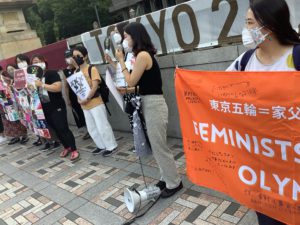
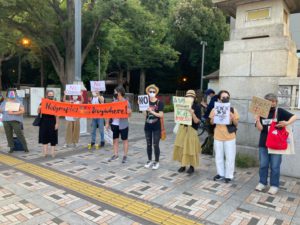
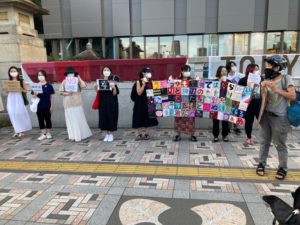
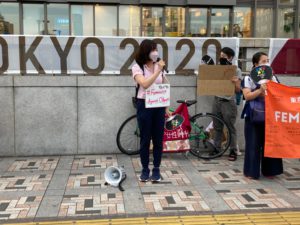
On July 23, 2021, the day of the Tokyo Olympic’s opening ceremony, AJWRC and more than 100 feminists protested against holding the Olympics at Harajuku station. We also called for protest action through social media with the hashtag #FeministAgainstOlympics and received various messages against the Olympics. Let’s keep raising our voices against Olympics!

Press Release

AJWRC-OMCT joint statement on women’s human rights at Human Rights Council

2021/09/22

on Jun 06, 2008 (2641 reads)

The AJWRC and the World Organization against Torture (OMCT) jointly delivered the following statement on June 5 during the 8th session of the UN Human Rights Council.

————————————-

Human Rights Council
8th session (2-18 June 2008)
Item 3: Discussion on human rights of women

Statement jointly delivered by the World Organisation Against Torture (OMCT) and the Asia-Japan Women’s Resource Centre (AJWRC)

Mr President, Dear Panellists,

The undersigned organisations warmly welcome the holding of this second discussion on the human rights of women within the Human Rights Council. In particular, we commend the inclusion of a segment on violence against women and the 2006 in-depth study of the UN Secretary General on this subject, as mandated by the General Assembly (Resolution 61/143).

Setting priorities in addressing violence against women is a difficult exercise that we are trying to do today. Indeed, as all areas identified by the Secretary-General in his study are interconnected, it seems to us that they must be addressed simultaneously. We consider that priority should be placed on follow-up, especially in the framework of the mandate of the Special Rapporteur on Violence against Women. We call on States to allocate sufficient means to ensure the follow up of her recommendations adopted following official country visits and in thematic reports, to inform the Rapporteur of progress made in implementing them, and to respond promptly and systematically to her individual communications. States should also reply positively to the requests for invitation by the Special Rapporteur (or extend standing invitations). Focusing on follow-up is a way to reinforce step by step the idea that violence against women is unacceptable and to set precedents that can serve as exemplary cases as a response to the “banalisation” of such violence.

Following this logic, the UPR should be seen as an indicator of priority issues that arise from country reviews, including violence against women. It should be a forum in which best practices, as well as the most recurrent lacunae at the national level, can be identified in this area. Based on these conclusions, we encourage the Human Rights Council to hold yearly meetings on one specific aspects or challenges identified during the UPR sessions.

Finally, it must be remembered that violence against women is often the result of multiple discriminations and that its prevalence and consequences are accentuated by deprivation of the enjoyment of civil, cultural, economic, political and social rights by women. In this regard, we reiterate our suggestion that Special Procedures mandate holders undertake joint missions, such as the Special Rapporteurs on Torture and Violence against Women.[1]

Thank you.


————————————————————
[1] As suggested by OMCT during the Interactive dialogue: Report of the Special Rapporteur on torture and cruel, inhuman or degrading treatment or punishment, Manfred Nowak, HRC 7, March 2008.


Press Release

Japan UPR: AJWRC-OMCT joint statement on Japanese Military Sexual Slavery

2021/09/22

on Jun 18, 2008 (3387 reads)

On June 12, AJWRC delivered the following statement jointly with the World Organisation Against Torture (OMCT) at the UN Human Rights Council to urge Japanese State to accept and act on all the recommendations in the Universal Periodic Review, including those on the Japanese Military Sexual Slavery during the World War II.
————————————

Human Rights Council
8th session (2-18 June 2008)
Item 6: Consideration of UPR-Report on Japan

Statement jointly delivered by the World Organisation Against Torture (OMCT), and the Asia-Japan Women’s Resource Center (AJWRC)

Mr President, Honourable Members of the Human Rights Council,

OMCT and AJWRC warmly welcome the comprehensive examination by the Human Rights Council of the human rights situation in Japan, including gender-based violence and discrimination against women.

We also welcome the fact that the Japanese State has expressed its determination, as a re-elected member of the Council, to implement its obligations under the human rights instruments and to address “situations of violation of human rights, including gross and systematic violations” worldwide in its voluntary pledges and commitments.

We expect the Japanese State to prove its commitment in this regard by addressing the “gross and systematic violations” of women’s human rights for which it is responsible, namely Japan’s military sexual slavery during World War II, as mentioned in paragraphs 15, 26, 32, 37 and 60 (al. 5 and 18) of the report of the Working Group[1]. Since the victims broke the decades of silence, a number of recommendations have been made by the international human rights bodies, including CEDAW and CAT. According to CAT, sexual violence and slavery in this context amount to torture and no statute of limitations should apply “that may prevent investigation, prosecution and punishment of these grave crimes.” It also considered that the remedies provided so far to the victims of military sexual slavery were inadequate and called on Japan to stop the “continuing abuse and re-traumatization” that result from “official denial of the facts, concealment or failure to disclose other facts, failure to prosecute those criminally responsible for acts of torture, and failure to provide adequate rehabilitation to the victims and survivors.”[2] However to date, the Japanese State has not acted on any of these recommendations, while a number of survivors have passed away without obtaining justice.

We call on Japan to urgently act on all recommendations including those on military sexual slavery without reservation, and set a best practice in ensuring remedies for the survivors of the most serious forms of violence against women in armed conflict. Otherwise, its failure to do so will raise serious doubt as to its ability to act as a responsible member of the Council.

Thank you.

——————————————————————————–

[1]During the review of Japan on May 9, several countries [France, the Republic of Korea, China, the Netherlands and the Democratic People’s Republic of Korea ] called on Japan to respond sincerely to the recommendations of the UN human rights mechanisms as well as the international community, and two related-recommendations are included in the conclusion.

[2] Further, in recent years, the United States, Canada, the European Union, the Netherlands and the Philippines have also passed resolutions urging Japan to apologize and provide redress for victims of these serious human rights violations.

Advocacy / Campaign

Statement rejecting “Gender equal” solutions that preserve patriarchal power structures and calling for immediate cancellation of the Tokyo Olympics and Paralympics Games

2021/09/15

On February 18, the Tokyo Organizing Committee of the Olympic and Paralympic Games appointed  Seiko Hashimoto to replace Yoshiro Mori, who was criticized for his sexist remarks and resigned.  The Japanese government and the International Olympic Committee (IOC) immediately announced their welcome of the appointment, trying to hastily bring an end to the sexism issue as if all obstacles to holding the Olympics had been solved.

The essence of Mori’s remark that “women talk too much” is not so much a discriminatory prejudice that generalizes women as inferior to men, but rather, as another Mori’s remark “the women of the Organizing Committee are prudent enough to know their place” indicates, an attempt to silence those who dare to raise objections to the intentions of influential figures by ridiculing them as “women talking too much”.  The approach of the Organizing Committee, the Japanese government, and the IOC to avoid decision-making based on transparent and democratic rules and to carry things out by consensus among homogeneous power-holders has remained unchanged. They initially tolerated Mori’s remark and later appointed his successor behind closed doors. The appointment of a woman as president is merely a stopgap measure for their crisis management to maintain this undemocratic patriarchal power. We categorically reject such a sham “gender equal” solution.

We also cannot overlook the issue of Hashimoto’s own sexual harassment being passed over behind her appointment as president presented like a symbol of gender equality. The violence of unwanted sexual contacts committed under certain power relationships that make it difficult to raise objections must be clearly recognized regardless of the gender of the victim or perpetrator. Despite the importance of such recognition, Hashimoto’s assault is treated as if it were not a serious problem and this will make it even more difficult for victims to come forward and may set back efforts to prevent sexual violence in the sports world.

Mori’s remarks and the subsequent responses of the Organizing Committee, the Japanese government, and the IOC reveal the structural violence of the Olympics itself, an event promoted advocating the ideals of gender equality and diversity. In the first place, the Tokyo Olympics began by silencing the voices of the victims of the accident at TEPCO’s Fukushima Daiichi Nuclear Power Plant, claiming that the effects of the accident were gone.  Since then, banners such as “Recovery from earthquake disaster” and “Co-existing”  have been used to justify the exclusion of the homeless, large-scale development that evicts public housing residents, environmental destruction, non-transparent financial transactions, nationalistic education, and increased police authority power.  Olympics have been inseparable from various forms of discrimination and violence, as evidenced by the experiences in other parts of the world, such as Rio de Janeiro and Pyeongchang.

Moreover, people of Japan and the world, especially the most economically and socially marginalized, are facing right now the crisis of health and survival that the distorted economic development brought about. It should no longer be tolerated to waste public funds for equally protecting people’s lives from the COVID-19 disaster on large-scale events with empty promises of equality in non-transparent manners. The greatest burden of such wasting is suffered by those who are not protected by stable jobs, positions, or property, and those who shoulder life-supporting care works under precarious and low-paid conditions or unpaid, many of whom are women. The Tokyo Olympics and Paralympics should be canceled immediately. And we must steadily push forward our long-term efforts toward a truly equal, just, and violence-free society.

Asia Japan Women’s Resource Center

February 22, 2021

Advocacy / Campaign

Statement on WAW! /W20

2021/09/14

We Need a Transformation to Just Economic System where Rights of All Women would be Fully Protected, Not “Women’s Empowerment” for the Sake of the Economic Growth

As Japan will host G20 Summit in June 2019, Japanese government is organizing the 5th International World Assembly for Women (WAW!) in 23-24 March 2019 in Tokyo, aiming at women’s economic empowerment, in collaboration with “Women 20 (W20),” an official engagement group of G20 to make policy recommendations regarding women.

As shown in the slogan “Closing the gender gap for new prosperity,” WAW!/W20 seeks for a happy marriage between the goal of the economic growth and the goal of gender equality. The event emphasizes that accelerating women’s active participation in labor market, corporate management, entrepreneurship and technology development will help states and business in their pursuit for the growth, and that building this sort of “win-win” relationship will lead to the global capitalism where “no one is left behind.”

As a matter of fact, however, leaders of the global capitalism has failed to create “win-win” relationship where the fruits of the growth would benefit all people. Rather, they have created and keep widening extreme gap where only 1% of world population get more wealth than the rest of 99%. Unacceptable level of poverty is found, not only in the places that lack the growth, but also in the areas where there is strong growth and among world wealthiest nations of G20. Thus, if we want to bring about equal global economy, we should ask what kind of ideologies and biases help justify such extreme injustice, rather than asking how to generate the growth and how to utilize women’s power for that purpose.

Among the G20, Japan is one of the nations where economic disparity is fast growing. Single mothers and single women are particularly vulnerable to fall into poverty, given the labor policies and social security systems that have made male-bread-winner-family as the norm, while shifting labor reproduction costs onto unpaid work borne by women in households. Furthermore, deregulation of labor, weakened social security and the rise of “self-responsibility” ideology in recent years have further shifted collective security to individual responsibility, increasing pressure on people for survival.

Although WAW!/W20 does touch upon some of those problems of gendered economic system, especially problems with work practices, its view on the economy is too narrow and too focused on the growth. We are afraid that this sort of arguments for gender equality with strong focus on the growth may not only fail to address gender bias embedded in the global capitalism, but also justify rights violation against people who don’t conform to the dominant labor and family models, driving division of women between those who could contribute to the growth and those who could not.

We are especially concerned about the lack of discussion about rights of migrant women who are often placed at the bottom of the global economy and made invisible in the framework of national economies. The serious problems of declining population and the lack of labor force that Japan faces with are results of the existing economic system that has ignored care and reproductive labor as just “women’s work.” However, rather than addressing these fundamental contradictions of the economic system, Japanese government and business leaders are increasingly depending on migrant workers as cheap labor that they do not care about its reproducing costs.

Migrant women have experienced the double bind of racial and sexual discriminations embedded in Japanese economic system. They are expected to take over underestimated “women’s work” such as care work, household work and unstable manual labor that have been borne by Japanese women, while supporting their own families with insufficient public support. Those on unstable residential status are especially vulnerable to serious sexual violence or domestic violence due to racial and sexual discriminations. Particularly vulnerable are those in Japan on trainee status. Their fundamental rights as workers including reproductive health and rights are severely restricted, as shown in the cases or serious human rights violations where female trainees who get pregnant are forced to return home or abort, and even arrested for abandoning the newborn child for the fear or being forced to return.

If Japanese government, corporations and leaders of the global economy truly seek to achieve economic empowerment of ALL women, they should look at the reality that the existing economic system to pursue the growth while neglecting needs of human reproduction has caused serious social damages, and that social damages have been transferred onto most vulnerable people such as migrant women who face gender and racial discriminations.

While WAW!/W20 celebrates “diversity,” this term should not be used to justify disparities among women and difficulties faced by women who experience not only gender-based discrimination but also discriminations based on nationality, class, race and other factors. We reject “women’s empowerment” for the sake of achieving the growth, which would benefit only well-endowed women at the expense of underprivileged women. We demand fundamental transformation to a just economic system where rights of all women and all people are fully protected.

22 March 2019

Asia-Japan Women’s Resource Center

Solidarity Network with Migrants Japan

Statement on WAW! /W20:We Need a Transformation to Just Economic System where Rights of All Women would be Fully Protected, Not “Women’s Empowerment” for the Sake of the Economic Growth

NEWS

【Voices from Japan】No.35 Japan’s response to Covid-19: Feminist analysis and perspectives

2021/09/03

Price: ¥1,500 (Shipping fee not included)

Please contact ajwrc@ajwrc.org for purchase and inquiries.
We accept card payments only.

[Contents]

Gendered impacts of Covid-19 in Japan: An overview
Hisako Motoyama

Invisibilization of dangers: What the pandemic and the nuclear disaster have in common
Nanako Shimizu

Fragile structure of women’s labor hit hard by Coronavirus: The high price of “diverse working styles” in the absence of a safety net
Mieko Takenobu

Novel coronavirus and the care sites: What will female nursing-care workers, who are at the front-line of saving lives, pass on to the future?
Asako Shirasaki

The reconfiguration of the gender order through handmade masks: Between handwork and science
Nozomi Mizushima/Akiko Yamasaki

Repeated discrimination against the sex industry regarding Covid-19 countermeasures compensation money
Sayaka Arimatsu

AJWRC  INFORMATION
170 marched in protest against violence and exclusion of homeless woman
Hisako Motoyama

Major activities of AJWRC: April 2020 to March 2021

NEWS

【Voices from Japan】No.34 Fighting against persistent gender discrimination in Japan

2021/09/03

Price: ¥1,500 (Shipping fee not included)

Please contact ajwrc@ajwrc.org for purchase and inquiries.
We accept card payments only.

[Contents]

Open the Black Box: Organization established to support Shiori Ito’s court case
Ching-ja Yang

Lawsuit filed by feminist researchers against House of Representatives lawmaker Mio Sugita to protest “anti-Japan” attacks
Kazue Muta

What was learned from the incident of discrimination against women at Tokyo Medical University
Yukiko Tsunoda

Restrictions against migrant women’s bodies during pregnancy and birth: Will reproductive rights within the new “Specified Skilled Worker” residence status be protected?
Makiko Ando/Sachi Takaya

Can W20 represent women?
Asia-Japan Women’s Resource Center/Solidarity Network with Migrants Japan

An assembly held one year after the sexual harassment case committed by the administrative vice minister of the Ministry of Finance: Calling for adoption of the International Labour Organization Convention by diverse victims in solidarity
Mieko Takenobu

The #KuToo (freedom of footwear) campaign: Stamping out sexist customs by focusing on shoes
Yumi Ishikawa

Unfreedom between freedom and sponsorship: The case of the
suspension of the Aichi Triennale 2019 exhibition
Yoko Shida

Big appeal for protest against the weapons fair at Makuhari Messe
Rie Kanemitsu

Reinforce the cornerstone of the women’s movement: Women’s March Tokyo 2019
Kari Tsushima

Make the Olympics history: “Anti-Olympics one year to go! International Get-Together!”
Kumiko Sudo

AJWRC INFORMATION

Symposium report: Feminism and transgender exclusion

Major activities of AJWRC: April 2019 to March 2020

Publication

【Voices from Japan】No.33 Constitutional Revision and the Imperial System of Japan – from the Perspective of People’s Lives

2021/09/03

Price: ¥1,500 (Shipping fee not included)

Please contact ajwrc@ajwrc.org for purchase and inquiries.
We accept card payments only.

[Contents]

FEATURE:Constitutional Revision and the Imperial System of Japan – from the Perspective of People’s Lives

Introduction: Fighting the Internalized Disease in our own Bodies
Mieko Takenobu

Women in Okinawa and the Constitution
Harumi Miyagi

The Violence called “Traditional Culture” of the Emperor System — Nyoninkinsei (Women banned from entering) and System of Patriarchy
Daiko Sakurai

Discrimination and the Imperial System — From the Zainichi (resident) Korean Perspective
Rimyong Park

Representation of the Imperial Family in Women’s Weekly Magazines
Yuki Senda

WOMEN’S NEWS IN JAPAN

Nyoninkinsei is Sex Discrimination, Not a Tradition!
Michiyo Hata

The Life of Shin-Do Song
Ching-Ja Yan

Sexual Harassment by Former Administrative Vice Finance Minister:Will it be a Watershed for Japanese Society?
Yoshiko Hayashi

Work-Style Reform: Women Lost the Information War
Mieko Takenobu

AJWRC Information

Report on the CSW 62
Shioka Hosojima

Major Activities of AJWRC: April 2018 to March 2019

Publication

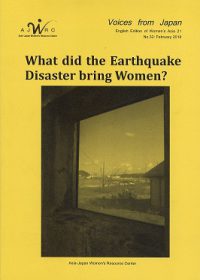
【Voices from Japan】No.32 What did the Earthquake Disaster bring Women?

2021/09/03

Price: ¥1,500 (Shipping fee not included)

Please contact ajwrc@ajwrc.org for purchase and inquiries.
We accept card payments only.

[Contents]

FEATURE:What did the Earthquake Disaster bring Women?

Introduction
Kuniko Funabashi

Six Years since the Great East Japan Earthquake:the New Horizon Created by Lobbying Activities
Akiko Domoto

Disaster Risk Reduction: Women Make it Possible
Kiran Bhatia

Living Under the Shock Doctrine
Mieko Takenobu

Human Rights Education for Women Missing in Disaster Area— Report from the Practitioner of Employment Assistance in Minamisanriku
Interview with Yuko Kusano

Becoming Stronger and Kinder: Carrying on Living in Fukushima in a Paradoxical Situation
Interview with Hatsue Munakata

Women Protesting the Construction of an Incinerator for Radioactive Waste
Nakako Wada

WOMEN’S NEWS IN JAPAN

Asian Survivors of the “Comfort Women” System Visit Japan to Criticize the Japanese-Korean “Agreement”
Yuka Okamoto

Women’s March Tokyo Opens Up New Space
Karin Koretsune

Forced Sterilization of People with Disabilities:The Japanese Government Needs to Apologize and Compensate!
Keiko Toshimitsu

Aiming to Pass on the ‘comfort women’ Struggle to the Next Generation: The Kibo-no-Tane (Seeds of Hope) Foundation
Satoko Nagayama

AJWRC Information

Fieldwork Tour Report:Acknowledging Discrimination Against Women with Illness and Disability at The National Hansen’s Disease Museum
Talk by Yukako Ohashi

Major Activities of AJWRC: April 2017 to March 2018

Publication

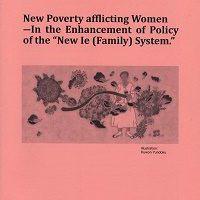
【Voices from Japan】No.31 New Poverty afflicting Women ― In the Enhancement of Policy of the “New Ie (Family) System”

2021/09/03

Price: ¥1,500 (Shipping fee not included)

Please contact ajwrc@ajwrc.org for purchase and inquiries.
We accept card payments only.

[Contents]

FEATURE:New Poverty afflicting Women ― In the Enhancement of Policy of the “New Ie (Family) System

Opening note for this special edition
By Mieko Takenobu

[Dialogue] New Poverty afflicting Women
By Mieko Takenobu & Kaori Katada


Poverty Spiral among Women and Children Forced to Flee from Fukushima after the Nuclear Meltdown
By Chia Yoshida

Hidden Poverty of Women Living with Their Parents:Case Examples of Young Single Women
By Yuko Iijima

Foreign Migrant Women and Poverty: An Interview with Motoko Yamagishi Compile

WOMEN’S NEWS IN JAPAN

Suraj Case: The State’s Responsibility was Not Recognized by the Tokyo High Court

Separate Surnames for Married Couples by Choice: Response to Japan’s Supreme Court’s Grand Bench Decision

Missing Woman Found Dead in Okinawa. Former U.S. Marine Suspect Arrested

The Release of the Concluding Observations on the Combined Seventh and Eighth Periodic Reports of Japan by the United Nations Committee on the Elimination of All Forms of Discrimination against Women (CEDAW)

Article 24 Campaign Begins to Prevent the Amendment of Article 24 by LDP

Sexual Crime Committed by Group of Five University Students

Lawyer Mikiko Otani Elected as a Member of the Committee on the Rights of the Child

Hitotsubashi University Outing ― Holding a Memorial Gathering for a Lost Graduate Student

Libel against Daughter of Takashi Uemura ― In the Ruling by the Tokyo District Court, She Won the Lawsuit

AJWRC Information

Symposium Commemorating the 20th Anniversary of the Foundation of the Asia-Japan Women’s Resource Center: “Peacebuilding in East Asia ― Networking by Feminists”

Gender Café
Give it some Thought: Taking a Cue from the Election in Summer 2016 ― What does “Family” mean to you?

Major Activities of AJWRC: April 2016 to March 2017

Publication

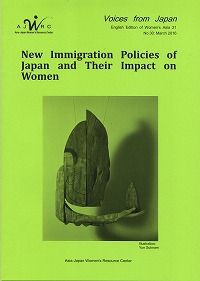
【Voices from Japan】No.30 New Immigration Policies of Japan and Their Impact on Women

2021/09/03

Price: ¥1,500 (Shipping fee not included)

Please contact ajwrc@ajwrc.org for purchase and inquiries.
We accept card payments only.

[Contents]

FEATURE:New Immigration Policies of Japan and Their Impact on Women

Introduction
By Mei Takahashi

The Hidden Side of the System of the Foreign Human Resources for Domestic Work Support
By Mieko Takenobu

Immigration Control Act Revision Proposal:
The Problem with “Reinforcement of Countermeasures against those Staying in Japan by Wrongful Means” and the Establishment of “Care Work” as a Status of Residence
By Yuki Maruyama

Will the Technical Intern Trainee Act Protect Female Workers?
By Yukiko Omagari

Problems within the Refugee Status Determination System for Asylum-seeking Women in Japan
By Manami Honda

The Story of Female Foreigners Living in Japan Interview with Jane Takeuchi

WOMEN’S NEWS IN JAPAN

Civil Societies Strongly Protest for the Security-related Bills to be Abandoned

Students’ Protests in Front of the Houses of Parliament – SEALDs’ Activities

The Japan-Korea “Agreement” Made without the Survivors is not a Resolution ~Calling for Realization of the “Recommendations”~

A Recent Movement Calling for an “Anti-Discrimination Bill”

The Abe Administration’s “Education Revitalization” and Selection of Middle School Textbooks

“Active Participation of All 100 Million People”
and the Motion for an Undesirable Amendment to Article 24 of the Japanese Constitution

The Supreme Court Held an Oral Proceeding on Separate Family Names for Married Couples

Japan Launches 1325 National Action Plan Alterations in the Last Stage which Distort the Government/Civil Society Dialogue

AJWRC Information

A Statement in Protest of the Forced Passage of the Security Bills and Demanding their Repeal

Testimonies of Postwar “Comfort Women” Survivors

A Meeting to Require Proper Immigration Policies Held in the House of Councilors

Labor + Migration + Culture – A Hong Kong Case Study

Major Activities of AJWRC

Publication

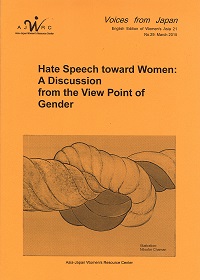
【Voices from Japan】No.29 Hate Speech toward Women: A Discussion from the View Point of Gender

2021/09/03

Price: ¥1,500 (Shipping fee not included)

Please contact ajwrc@ajwrc.org for purchase and inquiries.
We accept card payments only.

[Contents]

FEATURE:Hate Speech toward Women: A Discussion from the View Point of Gender

Introduction
By Mei Takahashi

Special Report
Deliberately Incited Discrimination against Women:
Gender-discriminatory remarks of public officials
By Nobuko Kamenaga

Fighting Hate Speech around the Comfort Women Issue
By Ban Chongja

Japanese Government on Discrimination: Issues of Discrimination against Korean Schools and Japanese Military “Comfort Women”
By Wooki Kim

Anti-Imperial System and Anti-Hate Speech 25
By Daiko Sakurai

So Much Hatred of Women:
The Link between the Homosocial Internet and Current Anti-Korean Sentiment
By Rie Kaiwa

WOMEN’S NEWS FROM JAPAN

Can Anyone See Any “Shining Women”?
— Prime Minister Shinzo Abe’s Policies toward Women

Doubts about the “All Women Can Shine” Policy in the Bill for the Promotion of the Activity of Women in the Workplace

In Opposition to the Construction of a New U.S. Air Station in Henoko

Revised ODA Increases the Risk of Diversion of Aid to Military Use

Japan gears up to Push Collective Self-defense

Amended Worker Dispatching Act Withdrawn

Japanese Government Decides Migrant Acceptance Expansion

Tokyo Assemblyman Hurls Sexist Jeers at Female Member

The Global Gender Gap Report (2014), Japan Ranked at 104 out of 142 Countries

Concerns about Responses to Cases of Domestic Violence and Abuse
— Ratification of the Hague Convention

First Mandatory Indictment for Sex Crime Declared Not Guilty

Reports on “Comfort Women” and Media in Crisis
― Attacks on the Asahi Shimbun

Damages Claimed for Hate Speech

The Final Yayori Awards Go to 2 Activists

Joint Statement
Protesting the Government’s Hasty Decision to Introduce “Foreign Human Resources for Domestic Work Support” and Demanding Ratification of ILO Domestic Workers Convention (C189)

Draft Release of Japan’s National Action Plan on Resolution 1325

AJWRC Youth Group Opens a Booth at Japan’s Leargest Music Festival

Major Activities of AJWRC: April 2014 to March 2015

Publication

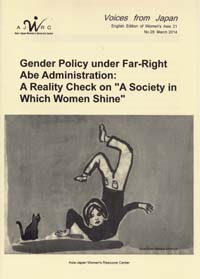
【Voices from Japan】No.28 Gender Policy Under Far-Right Abe Administration: A Reality Check on “A Society in Which Women Shine”

2021/09/03

Price: ¥1,500 (Shipping fee not included)

Please contact ajwrc@ajwrc.org for purchase and inquiries.
We accept card payments only.

[Contents]

FEATURE:Gender Policy Under Far-Right Abe Administration: A Reality Check on “A Society in Which Women Shine”


Introduction
By Hisako Motoyama

The Contradictions of the “Utilization of Women”: Neoliberal-Neoconservative Government and Its Use of Women of the Global Middle Class
By Keiko Kaizuma

Can Japanese Women Continue to Work with the Three-Year Extension of Childcare Leave?
By Kazuko Sakai

Facing Protests, Government Dropped “Women’s Notebook”

Deterioration of the Welfare System Invites Setbacks for Women’s Rights
By Hisako Motoyama

AJWRC Statement: Scrap the “Public Assistance Act” Amendment that Deteriorates Women’s Human Rights

WOMEN’S NEWS FROM JAPAN

Protests Increase over Osaka Mayor’s “Comfort Women” Remarks

Supreme Court Decides Discrimination of Children Born out of Marriage as Unconstitutional

Women’s Groups Join Discussion for Japanese 1325 NAP

ICESCR Recommends Gender Equality for Govt Disaster Reconstruction Plan

Japan Worsening Global Gender Gap at 105th

AP Findings Reveal Impunity of US Military Sex Crimes in Japan

Attack on Korean School Ruled as a Hate Crime

Global Day of Action for Commemoration of “Comfort Women”: Campaign Launched to Set August 14

Korean Students Filed State Compensation Case against Exclusion from School Fee Exemption Policy

State Secrecy Law Passed Amid Growing Protest

“Fashion Resistance to Militarism” 3rd Annual Political Fashion Show Hosted by AJWRC Youth Group

Major Activities of AJWRC: April 2013 to March 2014

Publication

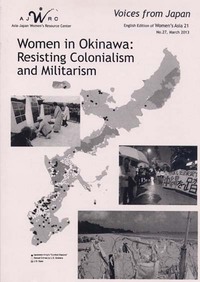
【Voices from Japan】No.27 Women in Okinawa: Resisting Colonialism and Militarism

2021/09/03

Price: ¥1,000 (Shipping fee not included)

Please contact ajwrc@ajwrc.org for purchase and inquiries.
We accept card payments only.

[Contents]

FEATURE: Women in Okinawa: Resisting Colonialism and Militarism

Introduction
by Hisako Motoyama

“Women and Military” from Okinawa’s Perspectives;
Comfort Women and “Mass Suicides” in Zamamison
by Harumi Miyagi

Protesting U.S. Military Violence for 67 Years
by Suzuyo Takazato

Rage Over Yet Another Case of Sexual Violence by U.S. Soldiers in Okinawa
by Hisako Motoyama

Prostitution within a Base-Dependent Economy
by Akane Onozawa

Okinawan Women’s Reproductive Rights under Japan-U.S. Joint Domination
by Kayo Sawada

What the ‘Grand Narrative’ Leaves Out:
The Stories of Okinawan Women who Married American Men and Immigrated to the U.S.
by Wesley Ueunten

Women’s News from Japan

Abe Wants to Revise the 1993 Official Apology over “Comfort Women”

Photo Exhibit on “Comfort Women” Cancelled by Right Wing’s Pressure

Korean Constitutional Court Orders Negotiation over Compensation for “Comfort Women”

The 2012 Yayori Award for Women’s Human Rights Activities

Major Activities of AJWRC (March 2012 to March 2013)

Publication

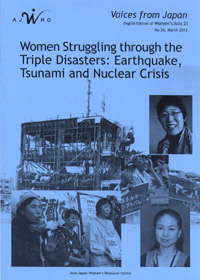
【Voices from Japan】No.26 Women Struggling through the Triple Disasters: Earthquake, Tsunami and Nuclear Crisis

2021/09/03

Price: ¥1,500 (Shipping fee not included)

Please contact ajwrc@ajwrc.org for purchase and inquiries.
We accept card payments only.

[Contents]

FEATURE: Women Struggling through the Triple Disasters: Earthquake, Tsunami and Nuclear Crisis
Breaking the Structure that Silences Women
by Mieko Takenobu

Believing in the Recovery of this Place:
A Letter from Fukushima
by Yumiko Nihei

Exclusion of Women from
Reconstruction Decision Making Process
by Hisako Motoyama

Violence against Women in the Disaster Situation
by Keiko Kondo

Disproportionate Impacts on Female Workers
by Midori Ito

Relief Activities for People with Disabilities
by Noriko Seyama

Relief Activities for LGBTI People in the Affected Areas
by Kaoru Ozawa

Communities Divided by the Nuclear Power Plant:
A Story from Fukushima
by Ayako Ohga

A Mother’s Dilemma over Food Contamination Following the Nuclear Disaster
by Naoko Yamaga

Resisting the Pressure of Stereotypical Motherhood
by Yukako Ohashi

Into Our Own Hands: The Mother’s Movement against Radiation Contamination and Public Participation in Science and Technology
by Nozomi Mizushima

Women’s News from Japan
The 2011 Yayori Award for Women’s Human Rights Activities

16 Days of Activism against Militarism and Violence against Women:
What Does “Peace” and “Security” Mean to Women?
Newspaper Clippings
Major Activities of AJWRC (March 2011 to March 2012)

DOCUMENTS